Alternatives
11 Exa Alternatives, Matched to the Part You're Replacing
Need an Exa alternative? Replace only the part you use: Tavily, Brave, Linkup or Parallel for source text, a SERP API for Google, SearXNG to self-host.

I would replace the part of Exa the application actually needs, rather than pick one winner for every workflow. Tavily, Brave, Linkup and Parallel belong on a content-grounded search shortlist; a Google-SERP provider fits ranking data, while Firecrawl and self-hosted tools solve different retrieval and operations problems. Tavily, Brave, Linkup, Parallel, Firecrawl.
Short on time?
Here's my take
- Search with source text
- Shortlist Tavily, Brave or Linkup
- Compare required output, depth and content rights rather than unsupported quality rankings.
- Google rankings and SERP data
- Inspect a dedicated SERP provider
- apiserpent.com has low documented Web-unit rates, while other routes change commitments and features.
- Search plus page scraping
- Inspect Firecrawl separately
- Its Search credits and requested scraping are separate charges.
Prices verified . Sponsors cannot buy a verdict or a position.
Start with my search API overview if the categories are unfamiliar. This guide is for replacing an Exa requirement; it does not rank providers by output quality or repeat the broader Tavily alternatives shortlist.
What are you replacing in Exa? #
Usually just one of its products. Exa spans Search, known-URL Contents, Answer, Agent and Monitors. An alternative that returns links may satisfy one requirement and leave the page-text or research stage unfilled. Pricing, Search, Contents, Agent.
| Required replacement | Options I would inspect | Constraint to keep visible |
|---|---|---|
| Search with usable source content | Tavily, Brave LLM Context, Linkup, Parallel | Output scope, depth, data terms and model work |
| Google SERP structures | apiserpent.com, Serper, SearchApi, DataForSEO | Engine/locale, result depth and purchase model |
| Search followed by scraping | Firecrawl | Search and scraping consume separate credits |
| Self-operated metasearch | SearXNG | JSON access, engine terms, hosting and blocks |
| Self-operated browser SERPs | OpenSERP | Browser/proxy operations and upstream rights |
| Cited structured research | Compare each research/answer product explicitly | A Search endpoint alone is not Exa Agent |
Sources: Tavily, Brave, Linkup, Parallel, apiserpent.com, Serper, SearchApi, DataForSEO, Firecrawl, SearXNG, OpenSERP.
Need search results with source text? #
For content-grounded search, I’d look at Tavily, Brave, Linkup and Parallel. Tavily is worth inspecting when depth-based Search and its documented client/MCP ecosystem fit. Basic Search uses one credit and advanced two; at PAYG’s $0.008/credit the base inputs are $8 or $16 per 1,000 calls, before separately confirmed allowances. Search, credits, Python, JavaScript, MCP.
Production is documented at 1,000 RPM, distinct from development limits. Tavily’s terms restrict third-party performance disclosure and include AI input/output improvement provisions, so this is a documentation comparison rather than a quality test. Limits, Terms.
Brave LLM Context is worth inspecting when extracted chunks and source metadata are the desired input. Search lists $5/1,000 requests with a $5 monthly credit and a required card, but general terms restrict storage, redistribution and AI evaluation unless separate rights apply. Context, plans, pricing, terms.
Its official MCP repository supplies an integration route, not proof of negotiated rights or a connection I made. I would resolve the output grant before storing a corpus. MCP.
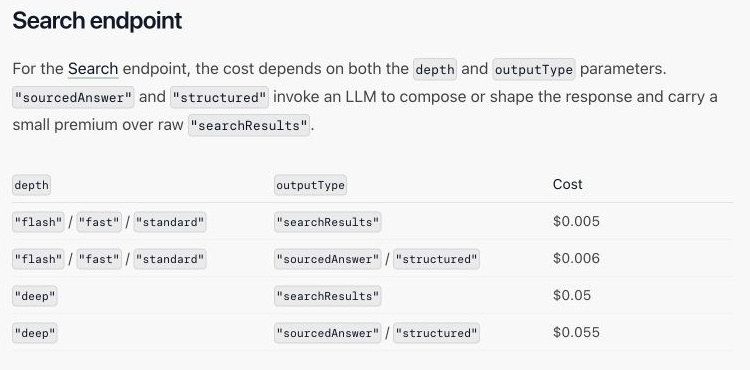
Linkup is worth inspecting for raw search, sourced answers or structured output with an explicit depth choice. Flash/fast/standard searchResults cost $0.005/call, answer/structured $0.006, while deep is $0.05/$0.055; the cheapest range is not the deep price. Platform pricing, Search overview.
Flash is documented as alpha. The eligible professional-email monthly $20 top-up is conditional, and the MCP server’s search/fetch/research tools still require an account key. Overview, pricing, MCP.
Parallel is worth inspecting for an objective/query workflow returning excerpts. Turbo/Fast list $1/1,000 ten-result searches, Basic/Advanced $5, with additional results billed separately; advertised free requests and credit offers should not be added as guaranteed independent allowances. Pricing, Quickstart.
Parallel’s current customer terms let it use customer inputs and outputs to train and improve its models, under a broad data-use licence. I would compare the documented workflow and contract, without adopting vendor performance comparisons. Customer terms.
What if you need Google results instead? #
Then a Google SERP provider is the better fit. apiserpent.com has a useful documented price structure for sporadic or larger SERP workloads: Web units cost $0.60 Default, $0.30 Growth, $0.10 Scale, $0.05 Enterprise or $0.03 Enterprise Plus per 1,000. Those tiers start at $100/$500/$1,000/$1,250 deposits, and your best deposit in a calendar month sets the price for all your deposits that month. Pricing, FAQ.
Quick uses one unit per call; Deep uses one unit per requested page up to ten. Purchased credit does not expire, credit you already hold keeps the price you bought it at and promotional credit has separate expiry, so I would not mix old/new balances into one synthetic invoice. Pricing, FAQ.
Quick Google is organic-only; Deep has optional SERP features, and AI Overview differs from the separately priced AI Mode add-on. I read the docs for its hosted MCP server at api.apiserpent.com/mcp (I did not connect to it): you send your API key in a header, and you get one tool per endpoint, about 50 across web, news, images, shopping, Maps, AI ranking, YouTube and social or marketplace sources. Clients that can send a header, such as Claude Code, Cursor and VS Code, can use it; web connectors that cannot send one can’t. Docs.
What it doesn’t have is a general fetch-a-page tool or page-extraction endpoint, so it does not replace Exa Contents. Public terms also do not establish a provider SLA or legal indemnity. Docs, Terms.
Serper offers prepaid packs starting $50/50,000 with six-month paid-credit expiry and a one-time 2,500-query trial. SearchApi lists monthly commitments such as $40/10,000 and $100/35,000. DataForSEO starts at $0.60/$1.20/$2 per 1,000 ten-result SERPs for Standard/Priority/Live, with depth and feature multipliers. Serper, SearchApi, DataForSEO.
I would choose among those only after fixing engine, locale, depth and purchase horizon. None automatically replaces Exa’s known-URL Contents or Agent workflow.

What about search plus scraping? #
Firecrawl covers both steps, but charges for each one. Ordinary Firecrawl Search costs two credits per ten results, rounded up; the documented gov category adds no search credits. Requesting scraping adds one credit per page; PDFs cost per page and JSON adds four credits per page, so the search headline is not full-page scraping for two credits. Search documentation.
The current pricing page lists 1,000 free credits monthly and annual-billed Hobby at a $16/month equivalent for 5,000 credits. The annual commitment should remain beside the figure rather than be presented as a cancel-anytime $16 monthly plan. Pricing.
I would inspect this route when the missing step is turning discovered URLs into requested scraped output. I would still confirm target permission and the exact extraction options.
Can you self-host instead? #
You can, with SearXNG or OpenSERP, but you take on the operations. SearXNG is AGPL metasearch software whose JSON format must be enabled; many public instances disable it. OpenSERP is an MIT browser-rendered search project with page extraction across six named engines. Neither software licence supplies a guaranteed hosted index or blanket rights to publisher content. SearXNG API, repository, OpenSERP.
SearXNG’s March Google HTTP 403 issue records both an upstream failure and a later fix. I read that as a maintenance consideration, not evidence that all current instances are down. Issue 5867.
I would choose self-hosting only when control justifies ownership of hosting, engine policies, proxy needs, updates and failure handling. Free software alone does not establish a lower total operating bill.
Which replacement would I shortlist first? #
For source-grounded search, I would shortlist by required return format and data terms; for Google ranking work, I would move to a SERP provider; for search-to-scrape, I would price Firecrawl’s separate stages. If the requirement is Exa Agent, I would compare task output, caps and structured-research controls directly. Exa Agent, Ultra caps.
Before migrating, remember that Exa includes text/highlights for the first ten Search results and supplies categories, filters, clients and MCP. Its query-data/privacy and undated public terms need review too; I would not replace an included feature only to purchase it again elsewhere. Changelog, Search, MCP, privacy, terms, JS releases, Python releases.
The consulted comments raise architecture, terms and historical budget questions, but do not establish a consensus or measured quality ranking. The G2 seller page also mixes Exa/Websets and shows incentivized reviews; I have not turned it into a product score. Architecture comment, terms comment, historical cost, discussion, review page.
If you are staying with Exa and only need to budget it, my Exa pricing breakdown works through modes, extra results and Agent runs. For more context, read Tavily versus Exa, Brave Search API alternatives and free web search APIs.
FAQ #
What is the closest Exa alternative? #
For content-grounded search, I would shortlist Tavily, Brave LLM Context, Linkup and Parallel according to output and contract needs. None is established as a universal quality winner by this documentation review. Tavily Search, Brave Context, Linkup, Parallel.
Can a Google SERP API replace Exa? #
It replaces the search-results requirement when Google engine, locale and SERP structures are the goal. It does not automatically replace full-page retrieval, structured research or Exa Agent. apiserpent.com docs, Exa Agent.
Which alternative has low prepaid Web rates? #
apiserpent.com lists Web rates from $0.60 per 1,000 units down to $0.03 with a $1,250 Enterprise Plus deposit. Deep consumes a unit per requested page; cash commitment and output fit matter. Pricing, FAQ.
Is SearXNG a free hosted Exa API? #
No. It is AGPL metasearch software, and many public instances disable JSON. Hosting, engine access and maintenance remain your responsibility when self-hosting. Search API, Repository.
Does Firecrawl’s search price include page scraping? #
No. Ordinary Search costs two credits per ten results, rounded up; the gov category adds no search credits. Requested scraping adds page-based charges, with further PDF and JSON rules. Search billing.
Can I compare them all on cost per request? #
Only after defining the same deliverable, result depth, extraction work and model-token assumptions. Search calls, credits, pages, answers and research tasks buy different operations. Exa pricing, Tavily credits, Linkup pricing.
Sources
48 sources, accessed to .
Official pricing, docs, changelogs and status pages 37
- Exa API Pricing
- Search
- Contents
- Billing and Rate Limits
- Changelog
- Exa MCP
- Exa Privacy Policy
- Exa Labs Terms of Service
- Exa Agent
- Agent Ultra
- Credits & Pricing
- Tavily Search
- Rate Limits
- Tavily MCP Server
- Platform Terms of Use
- Python Quickstart
- JavaScript Quickstart
- Brave Search API
- Pricing
- Search API Terms of Use
- LLM Context
- Parallel Pricing
- Search API Quickstart
- Customer Terms and Conditions
- Linkup Pricing
- Search overview
- Linkup MCP Server
- SERP API Pricing
- SERP API Documentation
- SERP API FAQ
- Terms of Service
- SearXNG Search API
- Firecrawl Pricing
- Search
- Serper
- SearchApi Pricing
- Google Organic SERP API


