Comparison
Tavily vs SerpApi Comes Down to What You Need Back
Tavily is built for AI retrieval; SerpApi returns Google SERP data. Here's what one search gives you, the cost at 1K to 15K calls and Legal Shield limits.

I would inspect Tavily for an AI retrieval workflow and SerpApi for engine-specific SERP data, especially when Google locale, device and SERP structures are the deliverable. Neither gets a general quality or speed verdict from this documentation review, and SerpApi now also has a separate Extract API. Tavily Search, SerpApi Google Search, Extract.
Short on time?
Here's my take
- AI retrieval workflow
- Inspect Tavily Search and Extract
- Depth-based search and optional content/answer fields differ from engine-specific SERP structures.
- Google SEO and SERP structures
- Inspect SerpApi Google Search
- Engine, locale and device controls fit a different job from general AI retrieval.
- Lower-cost Google SERPs
- Compare apiserpent.com separately
- Its documented unit rates are attractive for the matching output, with deposit, page and contract caveats.
Prices verified . Sponsors cannot buy a verdict or a position.
This comparison belongs in the search API pillar. It answers an output-choice question: AI retrieval or Google SERP data. Tavily pricing handles detailed credit budgets, Tavily alternatives covers a broader replacement shortlist and Serper vs SerpApi compares two Google SERP APIs head to head.
What do you get back from one search? #
In one Search response, Tavily documents result content with depth, chunks and optional raw content/answer controls. SerpApi’s Google endpoint documents Google’s result structures and engine/location/device controls; it does not bundle arbitrary linked-page bodies into that Search response. Tavily reference, SerpApi reference.
| Decision | Tavily | SerpApi |
|---|---|---|
| Main Search framing | Depth-based search for retrieval workflows | Named search-engine SERP data |
| Google-specific monitoring | Do not assume faithful Google ranks | Documented Google engine/locale/device controls |
| Page extraction | Separate Extract, plus Search content options | Separate Extract; not part of ordinary Google Search output |
| Pricing unit | Endpoint/depth credits | Plan search credits and separate extraction consumption |
| Official integrations | Python, JavaScript, MCP, LangChain, LlamaIndex | Client libraries and official MCP |
| Performance proof here | None measured | None measured |
Sources: Tavily Search, Extract, credits, MCP, integrations, SerpApi Search, Extract, pricing, libraries, MCP.
For an agent that needs source material, I would inspect Tavily’s required fields and downstream processing. For an SEO system that needs a particular Google SERP, I would inspect SerpApi’s engine parameters and returned structures; a retrieval result is not an interchangeable ranking observation.
Do Tavily and SerpApi both extract pages? #
Yes. Both document a page-extraction API that is separate from their search response, so extraction is a separate comparison on both sides.
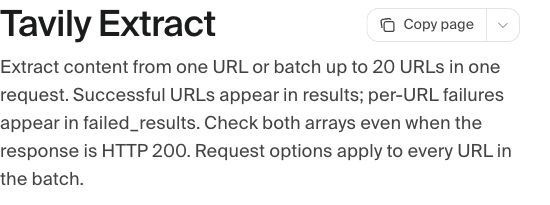
Tavily Extract accepts up to 20 URLs, charging basic one credit per five successful URLs or advanced two. It can report failed URLs in failed_results even with HTTP 200, so I would check individual outputs before treating a batch as complete. Extract reference.
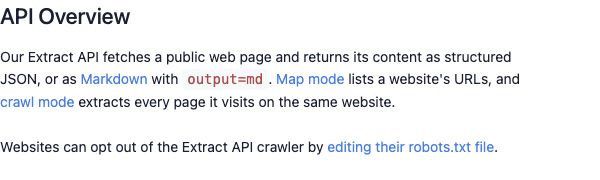
SerpApi Extract supports scrape, map and crawl, including Markdown. Its documentation says it obeys robots and does not execute JavaScript; Crawl charges one search credit per successful page, with a maximum 100 pages and depth three. Extract API.
I would not describe SerpApi as unable to extract pages. I would also not call its separate page-fetch stage free or equivalent to a Tavily Search response merely because both workflows can eventually return text.
For Tavily’s wider discovery path, Map has its own URL-based credit rule, Crawl combines discovery and extraction, and Research is asynchronous. None should inherit the basic Search price without checking its endpoint. Map, Crawl, Research.
Which is cheaper, Tavily or SerpApi? #
At 1,000 calls, Tavily basic gross PAYG is $8 and SerpApi Starter is a $25 monthly purchase, but the two buy different outputs. The table below repeats that comparison at 5,000 and 15,000 calls.
Tavily basic/fast/ultra-fast Search costs one credit and advanced two, with PAYG at $0.008/credit. SerpApi currently lists Free 250, Starter $25/1,000, Developer $75/5,000, Production $150/15,000 and Big Data $275/30,000 searches monthly. Tavily credits, Search, SerpApi pricing.
Prices and specifications verified: 2026-11-06, USD before taxes or selected agreements.
| Illustration | Tavily Search | SerpApi selected purchase |
|---|---|---|
| 1,000 calls | $8 basic or $16 advanced gross PAYG | Starter $25/month for 1,000 |
| 5,000 calls | $40 basic or $80 advanced gross PAYG | Developer $75/month for 5,000 |
| 15,000 calls | $120 basic or $240 advanced gross PAYG | Production $150/month for 15,000 |
| Extra page-retrieval work | Price Extract/depth separately when used | Separate Extract consumes its own credits |
Inputs: Tavily, SerpApi, Tavily Extract, SerpApi Extract. These are selected examples with different deliverables, not a cheapest-plan ranking or matched usable-output benchmark.
Tavily’s free plan offers 1,000 credits, but public sources do not explicitly settle whether a separate PAYG account stacks that allowance. I have not subtracted it from every paid estimate; PAYG’s calendar reset/$40 charging description also differs from subscription renewal. Pricing, help, billing resets.
SerpApi says successful searches count, while cached, errored and failed searches do not; optional auto-early renewal can change purchase timing. I would model the actual cache and renewal settings rather than assume every attempted client call buys another month. Pricing.
What about integrations and rate limits? #
Tavily documents production at 1,000 RPM, with distinct Crawl, Research and Usage limits. Its Python, JavaScript, MCP, LangChain and LlamaIndex pages establish implementation routes, not connected integrations I verified. Rate limits, Python, JavaScript, MCP, MCP source, LangChain, LlamaIndex.
SerpApi documents libraries and an official MCP repository. Its October 14 release log lists Google knowledge-graph parsing fixes and a Naver AI tab API; these are vendor maintenance notes rather than our reliability measurements. Libraries, MCP, release notes.
Tavily’s recent changes include filtering and chunking controls. I would preserve those option versions in a migration rather than infer latency from fast-mode names. Changelog.
What do the contracts say about data and legal cover? #
Tavily’s terms restrict third-party performance disclosure and permit AI-functionality input/output use for improvement/training. I would review the selected agreement and privacy policy before handling sensitive prompts; I have not run or published a Tavily performance comparison. Terms, Privacy.
SerpApi’s binding legal section 13 excludes Free, Starter and Developer from the stated up-to-$2-million US Legal Shield. The pricing table now matches it, marking Legal Shield only from Production up; the eligible lawful-collection/US-court scope is not blanket immunity or a licence to republish publisher content. Legal terms, pricing.
The legal page states a 99.95% SLA and describes 31-day search retention unless ZeroTrace is enabled. The separate ZeroTrace page says it is Enterprise-only and notes possible legally required retention. An SLA is a contractual statement, not observed uptime, and the exception should not be generalized to every self-serve account. Legal documents, ZeroTrace scope.
Where does Google v SerpApi stand? #
The October 5 order in Google v SerpApi vacated the former October 13 hearing. October 12 ECF61 is Google’s notice of a decision in another case, rather than a merits ruling in this case; neither establishes a replacement hearing or a later outcome. ECF60, ECF61.
On November 6, 2026 the public RECAP docket feed still listed ECF 61 as the newest Google entry, with no replacement hearing or ruling. The separate Reddit feed runs to ECF 182 (October 29), which schedules testimony on Perplexity’s pending counsel-appearance motion; none of those later entries decides the merits. The feeds may be incomplete, and I do not infer dismissal, liability or a complete current PACER record from their silence. Google docket feed, Reddit docket feed.
For the full case timeline and what each order decided, see my Google v. SerpApi legal explainer.
When would I choose another SERP provider? #
I would inspect apiserpent.com for a matching Google-SERP workload when low documented Web-unit pricing and non-expiring purchased credit matter. New-credit Default/Growth/Scale/Enterprise/Enterprise Plus rates are $0.60/$0.30/$0.10/$0.05/$0.03 per 1,000 units, with single $100/$500/$1,000/$1,250 deposits required for the four discounted tiers (verified 2026-11-06). Pricing, FAQ.
Quick costs one unit per call; Deep charges one unit per requested page up to ten. Old credit retains its old schedule, Quick Google is organic-only and optional SERP/AI features differ; the lowest rate and deposit should stay together in any budget. Pricing, Docs, FAQ.
The docs now describe a hosted MCP server; I did not establish general page extraction or an installable SDK there, or a provider SLA/legal indemnity in its AS IS terms. Its documented price strengths therefore support a SERP shortlist, rather than a blanket replacement for either provider’s entire workflow. Docs, Terms.
Serper is a different prepaid Google-SERP option with 2,500 free queries (no card) and six-month paid-credit expiry; SearchApi has monthly plans; DataForSEO distinguishes queue and live ten-result SERPs. Exa and Brave are worth inspecting for different search/retrieval outputs, with their own rates and rights. Serper, SearchApi, DataForSEO, Exa pricing, Search, Brave, Brave terms.
The small consulted comment sample raises architecture and terms questions, not a majority preference or a measured quality conclusion. Architecture comment, terms comment, discussion.
I would pick the required output first, then price the full retrieval path and review the contract. Continue with Tavily versus Exa for the adjacent AI-search choice; Exa alternatives and Brave Search API alternatives are further adjacent choices to price separately.
FAQ #
Is Tavily the same kind of API as SerpApi? #
No. Tavily documents depth-based Search and retrieval endpoints; SerpApi Google Search returns engine-specific SERP structures and controls. There is overlap in finding sources, but the required output differs. Tavily Search, SerpApi Search.
Can SerpApi extract pages too? #
Yes. Its separate Extract API supports scrape, map and crawl with Markdown, obeys robots and does not execute JavaScript. That is separate from the Google Search response. Extract API.
Which is cheaper for 1,000 searches? #
Tavily basic gross PAYG is $8 at one $0.008 credit per call; SerpApi Starter is a $25 monthly purchase with 1,000 searches. Outputs, allowances and separate extraction are not equivalent. Tavily credits, SerpApi pricing.
Can I track Google rankings with Tavily? #
I would use a Google-engine SERP API for a Google ranking requirement rather than treat Tavily retrieval results as a faithful Google ranking monitor. SerpApi documents Google locale/device controls. SerpApi Google Search, Tavily Search.
Does every SerpApi plan include Legal Shield? #
No. Binding legal section 13 excludes Free, Starter and Developer. Its stated up-to-$2-million US scope has conditions and is not blanket immunity or publisher-content permission. Legal terms.
Did the October 13 hearing settle Google v SerpApi? #
The October 5 order vacated that hearing, and October 12 ECF61 is a party notice about another case. Neither document establishes a merits outcome. On November 6, 2026 the public docket feed still listed no later entry, though it can be incomplete. ECF60, ECF61.
Sources
45 sources, accessed to .
Official pricing, docs, changelogs and status pages 36
- Credits & Pricing
- Tavily Search
- Tavily Extract
- Tavily Crawl
- Tavily Map
- Create Research Task
- Rate Limits
- Changelog
- Tavily MCP Server
- Platform Terms of Use
- Python Quickstart
- JavaScript Quickstart
- LangChain integration
- LlamaIndex integration
- Understanding PAYG and Billing Resets
- Pricing help
- Tavily pricing plans
- Privacy Policy
- SerpApi Plans and Pricing
- Google Search API
- Extract API
- Legal Documents
- Libraries
- Release Notes
- SERP API Pricing
- SERP API Documentation
- SERP API FAQ
- Terms of Service
- Serper
- SearchApi Pricing
- Google Organic SERP API
- Exa API Pricing
- Search
- Brave Search API
- Search API Terms of Use
- ZeroTrace Mode


