Alternatives
ScrapingBee Alternatives: 6 Picks and a Fix to Try First
Six ScrapingBee alternatives matched to why you'd switch, from known-page fetching to structured data and site crawls, and a config check to try first.

I would compare ScrapingBee alternatives from the capability you need to change. ScraperAPI or ZenRows belongs in a known-page shortlist, Zyte when target-tier/structured extraction is the requirement, Unlocker for managed raw-page delivery, and Firecrawl or Apify only when the job expands into ingestion or Actor workflows. ScraperAPI, ZenRows, Zyte, Unlocker, Firecrawl, Apify.
I would stay with Bee when its output, default/selected configuration and recurring payment settings fit. A smaller headline allowance, “auto” mode or a JSON response does not alone explain whether migration buys usable data at a better total cost. Bee API, pricing.
Short on time?
Here's my take
- For known pages
- ScraperAPI or ZenRows
- Match total weights and billing/output scope rather than promise a lower cost for every mode.
- If you need structured records
- Zyte API
- Choose extraction type/source and include extras, with actual target tiers still unknown.
- If you need crawls or Actors
- Firecrawl or Apify
- These are different requirements, not automatic replacements for all Bee endpoints.
Prices verified . Sponsors cannot buy a verdict or a position.
Which alternative fits which job? #
I would compare ScraperAPI or ZenRows for known pages, Zyte for structured entities, and Firecrawl for site ingestion. Prices and specifications verified: 2026-11-11. These are conditional fits from primary documents, not a ranking by success, popularity or independent usable-record costs.
| Reason to reconsider Bee | Option to inspect | Important tradeoff |
|---|---|---|
| Need a different known-page contract | ScraperAPI, ZenRows | JS/protection weights, output and billable statuses differ |
| Protected requests dominate cost | ZenRows adaptive, Zyte, Unlocker | Actual selected configuration/tier and output remain necessary inputs |
| Need entity schemas/custom fields | Zyte extraction | Extra type/token charges; schema still needs validation |
| Need Markdown/site crawl | Firecrawl | Ingestion scope differs from generic or dedicated endpoints |
| Need ready-made Actor jobs | Apify | Events and platform resources replace a simple request budget |
| Main concern is renewal | Stay and review Bee settings | Request ceiling, allowance and payment behavior are separate questions |
Could a settings change save you the move? #
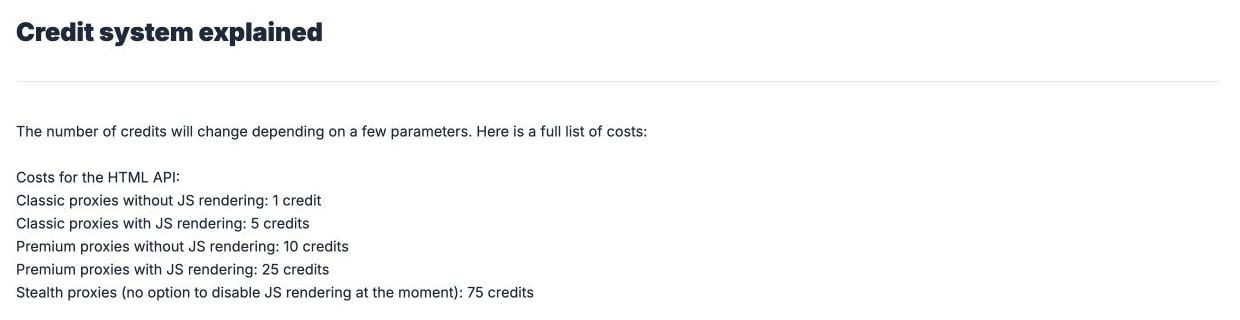
Bee’s ordinary HTML API defaults to five-credit JS, while plain with render_js=false is one. Premium-only is ten, premium-plus-JS 25 and stealth 75 with JS required; I would first check whether the job unnecessarily uses a more expensive path. HTML API, credit guide. My explainer on scraping API credits shows how those weights compare with ScraperAPI and ZenRows for the same request mix.
The current monthly ladder starts at $19 Hobby/75,000 credits/25 concurrency; the 1,000-credit signup offer is a trial, not a recurring allowance established here. Compare the correct billing period and feature mix before interpreting a competing number as cheaper. Pricing, trial support.
Normal billed statuses include 200/404/410/413, while transparent mode charges all target statuses below 500 and disables automatic retry. Auto GET/max_cost has its own scope, and the premium-AI total conflicts across the main docs/help article; I cannot use one generic formula to quote every endpoint. HTML API, credit guide.
Proxy mode keeps API defaults/costs and browser subresources can add requests. I would not migrate solely because another product exposes a proxy interface, and I would avoid copying examples that disable TLS certificate checks. Proxy mode.
ScraperAPI does the same job on different terms #
ScraperAPI is worth inspecting when its specific known-page contract fits better, but ordinary JS is ten credits, not Bee’s five. The standard generic plain/premium/both totals are one/ten/25; the entry monthly bundle is $49/100,000. Pricing, credit costs, JS FAQ.
What you change is the request/output and billing behavior, not only a key. I would check the precise target path, chosen options and missing-page/cancellation rules before translating a Bee job into standard ScraperAPI costs. Credit costs.
Its max_cost control can reject requests above a ceiling, while ordinary credit renewal and the PAYG (Scaling plan and up)/refund wording have separate rules. Full commercial terms and exact private overage rates were not obtained, so I would get applicable terms in writing before procurement. Cost control, billing FAQ.
I would not call ScraperAPI a universal cheaper-JS choice. The decision requires allowance, target features and usable-output costs, while this sample contains no account or invoice proof. The full head-to-head is in ScraperAPI vs ScrapingBee.
ZenRows puts several products in one wallet #
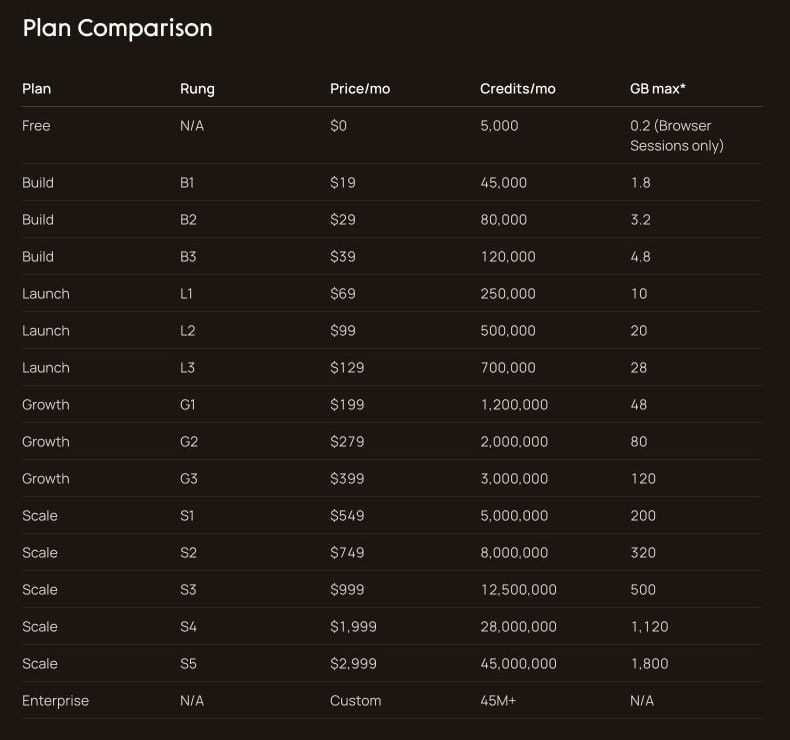
ZenRows is a close shortlist when its Fetch path and shared product wallet fit. Monthly Free is 5,000 credits and Build B1 is $19/45,000, with ordinary Fetch plain/JS/premium/both totals one/five/ten/25. Pricing, Fetch reference.
What changes is the interface/product scope: browser time/traffic and standalone proxy traffic use different units from Fetch. I would price only the required path rather than claim every shared-wallet feature is a free addition to a page-fetch job. Pricing.
Adaptive mode says it charges the successful configuration, but a returned page still needs field validation. Key caps are default-off and start-checked, can overshoot in flight or temporarily fail open, and exclude legacy proxies; those are not hard zero-spend guarantees. Adaptive, caps.
I would compare eligible packs with the next monthly rung, then keep payment/eligibility assumptions explicit. A lower base weight or richer wallet does not establish better output on the intended target. I compare the two plan ladders directly in ZenRows vs ScrapingBee.
Zyte adds structured extraction and site tiers #
Zyte makes sense to inspect when the work needs website-tier pricing or standard/custom entity extraction. Published PAYG HTTP spans $0.13–$1.27/1,000 and browser $1.01–$16.08, with a $100 standard PAYG ceiling; commitments add discounted rates, floors and ceilings. Pricing, pricing rules.
What you give up is one generic credit weight across all targets. Actual target tier, mode and extras are necessary before quoting a useful budget; the easiest-tier figure is not every website’s cost.
Standard extraction selects a data type/source, and custom attributes add an LLM/schema path and token cost. That differs from receiving raw HTML in an API envelope, and schema-shaped output can still omit unextractable fields or need factual checking. Extraction, custom attributes.
I would shortlist it for that entity-output requirement and separately validate representative authorized records. This research does not claim measured accuracy, cheaper matched targets or a connected integration.
Bright Data Unlocker hands you the raw page #
Bright Data Unlocker advertises 5,000 monthly free requests and $1.50 per 1,000 successful PAYG requests. Its product introduction describes managed delivery of raw HTML or a JSON envelope, not a structured-record or click-control guarantee. Pricing, introduction.
What changes is the chosen delivery product and its applicable billing/target scope. I would inspect a different structured-data or browser product if the task needs records or actions rather than assume Unlocker supplies every capability in one request. To weigh it against Zyte, Oxylabs and Decodo, see my web unblocker comparison.
When would Firecrawl or Apify fit better? #
Firecrawl fits a scrape/crawl ingestion requirement, with Markdown and structured page output and whole-site crawl behavior. It lists 1,000 Free monthly credits and Hobby $19/5,000, but selected endpoints/features and the difference between page scrape and crawl still matter. Pricing, scrape, crawl.
What you give up is a like-for-like generic endpoint assumption. I would inspect ingestion semantics, output acceptance and target scope, rather than tell every Bee customer to migrate to a crawler.
Apify instead compares as an Actor/platform workflow: Free $5 usage monthly, paid Starter $19, Scale $199 and Business $999, with resource and creator-event charging dependent on the selected Actor. The pricing page and Store docs now describe pay-per-event and pay-per-usage Actors; I would inspect the selected Actor’s model before budgeting. Pricing, Store billing.
That can be useful for a ready-made job, but it is not a simple credit-count replacement. I would preserve input/output and surrounding schedules/storage requirements before deciding the platform buys something the page API lacks.
So which one would I pick? #
For known pages, I would compare ScraperAPI or ZenRows only against a named missing requirement. For structured entities, Zyte; for managed raw delivery, Unlocker; for page/site ingestion, Firecrawl; for selected Actor workflows, Apify. I would stay when Bee already fits and the only proposed benefit is an unverified marketing claim.
Bee’s terms require target authorization, and no competing subscription establishes rights to arbitrary data. Review actual product terms and allowed scope before a live evaluation; this sample supplies no benchmark clearance or account change. Bee terms.
The scraping API pillar connects the layers. Use ScrapingBee pricing and ScraperAPI pricing for request weights, Zyte API pricing for tier/floor examples, ZenRows alternatives for the shared wallet, and Apify alternatives for workflow migration.
FAQ #
Which ScrapingBee alternative is closest for known pages? #
I would inspect ScraperAPI or ZenRows, matching the exact endpoint, features and billing/output rules. No measured reliability winner follows. ScraperAPI, ZenRows.
Does ScraperAPI charge fewer credits for JS rendering? #
Its documented generic JS total is ten versus Bee five. Actual plan and target configuration still decide the capacity comparison. ScraperAPI JS, Bee API.
Which alternative gives you structured entities? #
Zyte documents standard and custom extraction with selected source/type and extra costs; the resulting fields still need validation. Extraction, custom attributes.
Does a spending cap guarantee you won’t pay more? #
No such universal rule is established here. Request max_cost, credit balance and payment/renewal settings are distinct, and ZenRows documents cap overshoot/fail-open cases. ScraperAPI controls, ZenRows caps.
Can a crawler like Firecrawl replace a scraping API? #
No. Firecrawl’s scrape/crawl output fits an ingestion requirement, while dedicated page, search or proxy behavior needs its own comparison. Scrape, crawl.
Sources
26 sources, accessed .
Official pricing, docs, changelogs and status pages 26
- ScrapingBee plans
- HTML API
- Service terms
- Credit system
- Proxy mode
- Trial allowance
- ScraperAPI plans
- Request credit costs
- Plans and billing
- JS rendering FAQ
- Cost control
- Zenrows monthly pricing
- Fetch API reference
- Key credit caps
- Adaptive stealth
- Zyte pricing
- Zyte API billing
- Automatic extraction
- Custom attributes
- Web Unlocker pricing
- Web Unlocker
- Firecrawl pricing
- Firecrawl scrape
- Firecrawl crawl
- Apify pricing
- Store billing


